
The Seven Sacraments: Channels of Grace, Pillars of our Faith, and the Pathway to Holiness
-
Baptism finds its origin in Jesus Christ. He submitted to John’s baptism not because he needed cleansing, but to sanctify the waters and to show his solidarity with humanity. By commissioning his disciples to baptize all nations, Jesus opened the way for us to die to sin—both original and personal—and to begin a new life with God.
What Baptism Means
• New life in Christ — Baptism unites us to Christ’s death and resurrection and begins our journey as members of his Body.
• Gift of the Holy Spirit — Through Baptism the Holy Spirit draws us into holiness, enabling us to walk in the light of Christ.
• Call to discipleship — Baptized Christians are invited to trust Christ’s wisdom, deepen their love for him, and live out the Gospel.
Preparation and Schedule
• Baptism preparation for infants is usually held in the Social Hall at 6:00 PM on the first Wednesday of each month, except during Advent and Lent; consult the parish bulletin for exact dates and any changes.
-
Reconciliation is available each Saturday at 2pm, and may also be offered after 9am daily masses.
Not only does the Sacrament of Penance free us from our sins but it also challenges us to have the same kind of compassion and forgiveness for those who sin against us. We are liberated to be forgivers. We obtain new insight into the words of the Prayer of St. Francis: "It is in pardoning that we are pardoned."
Jesus entrusted the ministry of reconciliation to the Church. The Sacrament of Penance is God's gift to us so that any sin committed after Baptism can be forgiven. In confession we have the opportunity to repent and recover the grace of friendship with God. It is a holy moment in which we place ourselves in his presence and honestly acknowledge our sins, especially mortal sins. With absolution, we are reconciled to God and the Church. The Sacrament helps us stay close to the truth that we cannot live without God.
-
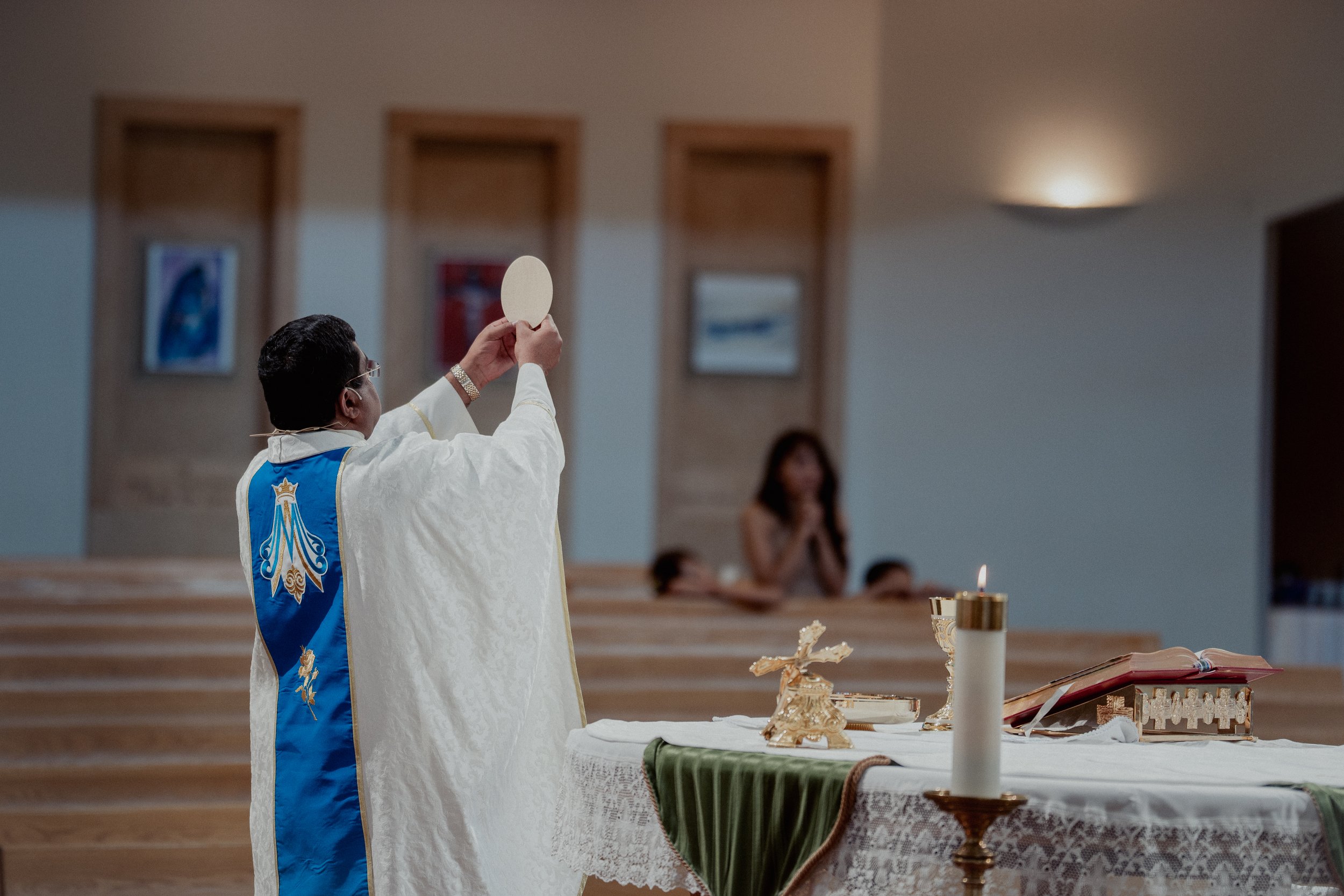
In the celebration of the Eucharist, bread and wine become the Body and Blood of Jesus Christ through the power of the Holy Spirit and the instrumentality of the priest. The whole Christ is truly present - body, blood, soul, and divinity - under the appearances of bread and wine, the glorified Christ who rose from the dead. This is what the Church means when she speaks of the Real Presence of Christ in the Eucharist.
If you or your child are ready to begin preparing for First Communion, the first step is to contact the parish office or our Director of Religious Education for school age children. Preparation typically includes participation in our parish Faith Formation program, regular Sunday Mass, and a period of sacramental preparation that is tailored to each person’s age and individual level of faith formation. Adults seeking First Communion generally participate in OCIA. Our staff will help you understand the steps, timelines, and formation needed so you can begin the process with confidence. Click HERE to contact us.
-
The prophets of the Old Testament foretold that God’s Spirit would rest upon the Messiah to sustain His mission. This prophecy was fulfilled when Jesus the Messiah was conceived by the Holy Spirit and born of the Virgin Mary. The Spirit descended upon Him at His baptism, and His entire mission unfolded in perfect communion with the Spirit. Before His Passion, Jesus promised that this same Spirit would be given to the Apostles and to the whole Church. After His death, He was raised by the Father in the power of the Spirit.
Confirmation deepens our baptismal life and strengthens us to be missionary disciples of Jesus Christ in our families, neighborhoods, society, and the world. Through this sacrament, we receive the grace to embrace the faith more deeply and to live it with conviction. Confirmation also brings the Gifts of the Holy Spirit—wisdom, understanding, counsel, fortitude, knowledge, piety, and fear of the Lord—which help us grow in holiness and build up the Church in loving service.
For those seeking Confirmation, the process begins by contacting the parish office or our Director of Religious Education. Preparation is shaped around a person’s age, prior formation, and spiritual readiness, and we will help you understand the steps and expectations involved. Confirmation is the final step of being fully initiated into the Catholic Faith for both youth and adults, completing the sacraments of Baptism, Eucharist, and Confirmation. Whether you are a teen preparing for the sacrament or an adult completing your initiation, our parish is here to accompany you.
Click HERE to contact us now.
-
Getting Married in the Catholic Church (Simplified Guide)
Marriage in the Catholic Church is a sacred commitment and requires sincere preparation.
Each person must:Be free to marry (never married before, widowed, or have a declaration of nullity).
Have known their fiancé for at least six months.
Be capable of making a mature, deliberate decision about marriage.
Have the emotional, psychological, and spiritual ability to live a faithful, lifelong Christian marriage.
Step 1: Provide Required Documents
The Church will need:
Recent baptismal certificates
Proof of First Communion and Confirmation
Affidavit of Freedom to Marry
Civil marriage license
Marriage Preparation Course certificate
Gather these documents early and keep them together for your priest or Marriage Coordinator.
Step 2: Meet With the Priest or Marriage Coordinator
The couple meets with the priest/Coordinator along with one witness for each person (someone who has known them since adolescence).
Prenuptial forms and affidavits are completed and signed at this meeting.Step 3: Attend Marriage Preparation Classes
Marriage preparation classes must be completed before a wedding date can be set.
Step 4: Schedule the Wedding
A wedding date is reserved only after all requirements and preparation are completed.
Do not book a reception hall until a priest confirms your date.
Weddings outside the Diocese of Reno require all documents to be submitted 9 months before the wedding.
Coordinate all ceremony details with Immaculate Conception Catholic Church to ensure compliance with church policies.
Planning the Ceremony
Couples may personalize their ceremony within Church guidelines.
Because Christ is present in the Blessed Sacrament:Music must be liturgical.
Attire for the entire wedding party should be modest.
All music, photography, video, flowers, and other arrangements must be approved in advance by the coordinator and music director.
Contact the wedding coordinator to finalize plans and provide your marriage license.
Rehearsal
Rehearsals take place in the presence of the Blessed Sacrament.
All participants must behave reverently and avoid disruptive behavior, gum, food, or drink.Wedding Day
The wedding party should arrive 30 minutes early to ensure an on‑time start.
Enjoy God’s blessing on your marriage.
-
Holy Orders is the sacrament through which Jesus Christ, the eternal High Priest anointed by the Father and filled with the Holy Spirit, continues to shepherd His Church. While all the baptized share in Christ’s priestly mission, the ministerial priesthood participates in it in a distinct way through this sacrament. The Catholic Church teaches that Holy Orders includes three degrees—bishop, priest, and deacon—united in one sacramental reality. Bishops are successors of the Apostles who receive the fullness of the sacrament and guide the Church. Priests serve as co‑workers with the bishop, preaching the Gospel, celebrating the sacraments, and caring for the faithful. Deacons, whether transitional or permanent, are ordained for service, charity, and the proclamation of the Gospel.
A vocation to Holy Orders is always a call and a gift from God. “Here I am, send me” (Is 6:8) expresses the generous response of those who discern this path. This call is recognized through prayer, participation in the life of the Church, and the guidance of those entrusted with helping a candidate discern God’s will.
Consecrated religious—such as sisters, nuns, brothers, and monks—do not receive Holy Orders, but they live a beautiful and essential vocation within the Church. Through vows of poverty, chastity, and obedience, they witness to Christ through prayer, community life, and a wide range of ministries that support the mission of the Church.
Please contact the parish office to speak with Father Philip if you feel called to explore a vocation or have questions about Holy Orders or consecrated life.
-
In the Church's Sacrament of Anointing of the Sick, through the ministry of the priest, it is Jesus who touches the sick to heal them from sin – and sometimes even from physical ailment. His cures were signs of the arrival of the Kingdom of God. The core message of his healing tells us of his plan to conquer sin and death by his dying and rising.
The Rite of Anointing tells us there is no need to wait until a person is at the point of death to receive the Sacrament. A careful judgment about the serious nature of the illness is sufficient.
When the Sacrament of Anointing of the Sick is given, the hoped-for effect is that, if it be God's will, the person be physically healed of illness. But even if there is no physical healing, the primary effect of the Sacrament is a spiritual healing by which the sick person receives the Holy Spirit's gift of peace and courage to deal with the difficulties that accompany serious illness or the frailty of old age.
Please don’t hesitate to contact the parish office as soon as possible if you or a loved one may need the Sacrament or if you have questions about what it involves. It is always better to reach out early—especially before scheduled surgeries or when a serious illness first appears—rather than waiting until an emergency. Anointing of the Sick is not “Last Rites,” but a sacrament of healing and strength meant to support the faithful throughout illness, frailty, or times of medical need.
You may call 775-358-5977 at any hour and on any day should this sacrament be required.
The Joy of Catholic Marriage!
A glimpse into the beauty of lifelong commitment, faith, and family.
Some scenes are illustrative and not filmed at Immaculate Conception Catholic Church.